As we navigate a rapidly changing, unpredictable world, one truth is becoming increasingly clear: our children need an education that fosters creativity, adaptable thinking, and self-direction—not one that asks them to conform to standardized molds. For over a century, Montessori education has been doing precisely that with extraordinary success.
The Traits of True Innovators
Across history, many remarkable creative thinkers, entrepreneurs, and visionaries credit their early Montessori experience with shaping their success. When we look at what drives innovation, we see core human qualities that traditional education often overlooks: curiosity, imagination, internal motivation, leadership, and a lifelong love of learning.
Here is a look at how these traits are nurtured every day inside our classrooms at The Renaissance International School.
1. Curiosity: Awakening the Desire to Explore
"I do not believe there is a method better than Montessori for making children sensitive to the beauties of the world and awakening their curiosity regarding the secrets of life."
— Gabriel García Márquez, Nobel Laureate author & Montessori alumnus
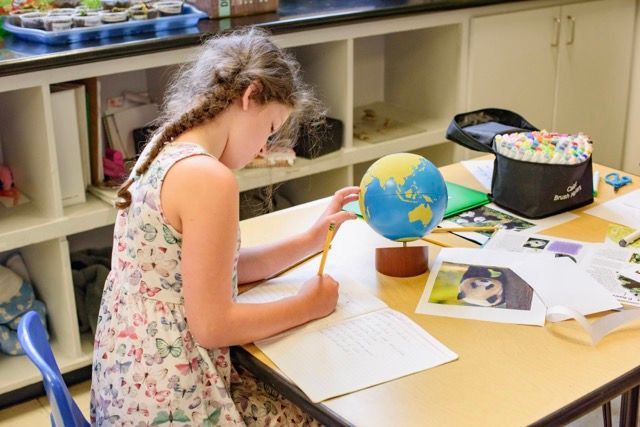
Rather than simply feeding children facts to memorize, our Guides spark their natural wonder through captivating stories and hands-on materials that lead to real self-discovery.
A wonderful example of this at TRIS is the First Great Lesson presented in our Elementary classrooms. This impressionistic story introduces the origins of the universe in a way that deeply fires the child's imagination. Every year, students return to this lesson with new developmental eyes, unlocking deeper questions about physics, chemistry, astronomy, and geology that propel their own independent research projects.
2. Imagination: The Engine of Human Invention
There is a persistent myth that Montessori education discourages imagination. In reality, Dr. Maria Montessori held the human imagination in the highest regard. She observed that while young children love real, tangible work, their power to imagine is the very key to abstract thought and creative innovation.
"Human consciousness comes into the world as a flaming ball of imagination... Our aim therefore is not merely to make children understand, but so to touch their imagination as to enthuse them to their inmost core."
— Dr. Maria Montessori, To Educate the Human Potential
In our prepared environments, we do not ask children to passively memorize theories. We offer grand ideas and sensory materials that allow them to visualize complex concepts, whether they are building 3D geometric models, exploring historical civilizations, or investigating biological systems.
3. Internal Motivation: Driven from Within
"I think it was part of that training of not following rules or orders, and being self-motivated, questioning what’s going on in the world and doing things a little bit differently."
— Larry Page, Co-Founder of Google & Montessori alumnus
In a Montessori environment, you won't find gold stars, sticker charts, or traditional letter grades. We deliberately eliminate external rewards because we want children to connect with their own intrinsic drive.
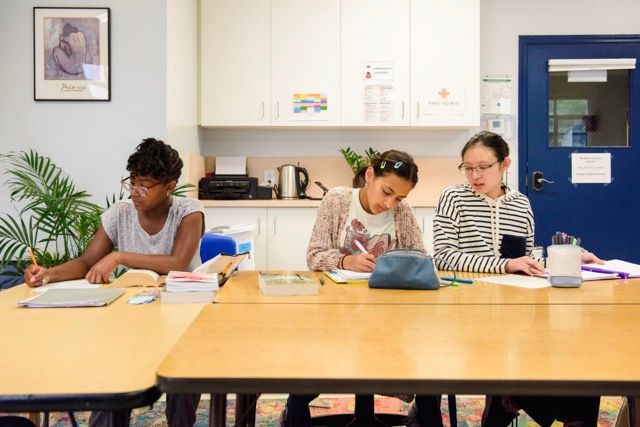
Through freedom within limits, students at TRIS choose their work, decide where to sit, order their daily tasks, and collaborate with peers. By practicing real decision-making every day, children develop authentic self-discipline and trust in their own capabilities—skills essential for modern leadership.
4. Leadership: Developed Through Multi-Age Communities
Our classrooms are structured around three-year age groupings, creating a natural, living community. Leadership in a Montessori setting isn't about who speaks the loudest; it grows organically as children transition through different roles.
- As younger students: They observe older peers, absorb high-level work, and receive gentle peer mentorship.
- As older students: They step into leadership roles—giving lessons to younger classmates, modeling grace and courtesy, and developing deep empathy and social responsibility.
"Only through freedom can individuals develop self-control, self-dependence, will power, and initiative. There is no education except self-education."
— Anne Sullivan, Teacher to Helen Keller
5. A Lifelong Love of Learning
Our ultimate goal at The Renaissance International School is not just academic preparation for the next grade level—it is nurturing a joy in learning that stays with a child for life.
Consider world-renowned violinist Joshua Bell, whose parents enrolled him in a Montessori school after finding him as a four-year-old making a makeshift stringed instrument out of rubber bands and dresser drawers.
Decades later—as one of the world's most celebrated musicians—Bell famously stood in a Washington, D.C. subway station dressed in ordinary clothes, playing masterworks on his multi-million-dollar violin for 45 minutes as an informal social experiment. His motivation? Pure, unadulterated curiosity and a passion to observe human interaction. That unquenchable drive to explore, test, and engage with the world is the hallmark of a Montessori mind.
Experience the Montessori Difference at TRIS
When you visit a classroom at The Renaissance International School, you don't just see children learning academics—you see young people building confidence, practicing creative problem-solving, and developing a deep respect for their community.
Curious to see these principles in action?
Schedule a Campus Tour
to observe our peaceful, vibrant classrooms firsthand.