
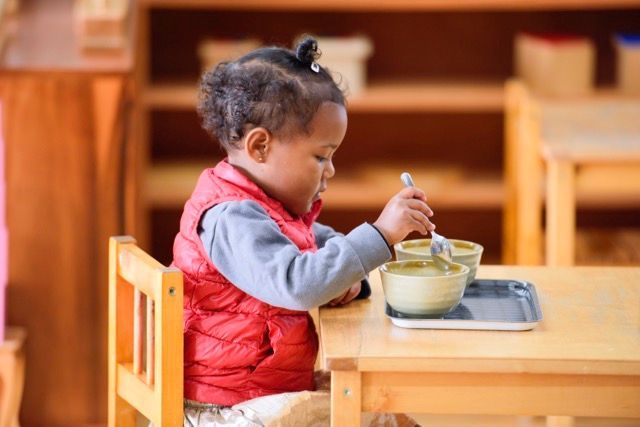
One of the greatest gifts of a Montessori education is the freedom to focus truly on the whole child—cognitive, social, emotional, and physical. At The Renaissance International School, our approach extends far beyond academic achievement. We are dedicated to nurturing essential life skills, emotional intelligence, and genuine human connection.
Our framework rests on a fundamental belief: children are naturally curious, inherently empathetic, and intrinsically motivated. When provided with an environment designed specifically for their developmental needs, children naturally deepen both their love for learning and their care for the community around them.
1. Prioritizing the Prepared Environment
At TRIS, social-emotional learning starts with the space itself. A prepared environment is a physical and psychological space designed to meet children’s sensitive periods for learning and their core human needs.
When children feel safe, respected, and physically capable in their surroundings, they are free to focus on their inner development. Our prepared classrooms support this by offering:
- Calm and Order: Clean, beautiful spaces with accessible materials that promote focus and reduce anxiety.
- Autonomy and Choice: Opportunities to make independent decisions, which builds confidence and self-regulation.
- Mixed-Age Communities: Varied social opportunities that mirror real-world dynamics, allowing children to practice grace and courtesy daily.
In these child-centered spaces, children learn to manage their energy, respect shared resources, and navigate social dynamics with natural poise.
2. Real-World Conflict Resolution & Peaceful Communication
In a Montessori setting, social challenges are not seen as disruptions to learning—they are the learning. We actively guide children as they learn to identify their feelings, put their emotions into words, and listen to the perspectives of others.
Rather than acting as arbitrators or judges who hand down punishments, our Guides serve as calm facilitators. We support students by:
- Naming and validating complex emotions.
- Teaching concrete self-regulation strategies (such as deep breathing or utilizing quiet reflection spaces).
- Facilitating peaceful, restorative conversations between peers.
- Guiding children to generate their own mutually agreed-upon solutions.
By practicing these steps daily, TRIS students gain practical conflict-resolution tools they can use independently—both inside the classroom and out in the wider world.
3. Empathy, Collaboration, and Respect for Others
Cultivating empathy requires experiencing different perspectives. Through shared care of our classroom environments and collaborative group work, children learn patience, cooperation, and mutual respect.
Our mixed-age classroom structure is essential to this process:
- Younger children feel supported and learn social cues from observing older peers.
- Older children step into mentorship roles, modeling emotional regulation, patience, and kindness.
This constant peer-to-peer interaction fosters a culture where differences are appreciated, and leadership is defined by helpfulness rather than authority.
4. A Deep Sense of Belonging and Community
Children thrive when they know they belong. At TRIS, we intentionally cultivate inclusive environments where every child's voice is valued.
Through group gatherings, collaborative projects, and shared responsibility for our school spaces, our students develop deep trust in one another. The long-term benefit of this social-emotional foundation is profound: TRIS children grow into empathetic, articulate, and resilient individuals who move through the world with goodwill and self-assurance.
Partnering Between School and Home
The social-emotional tools we build at school are most powerful when reinforced at home. Whether you are curious about how our Guides handle peer conflicts or want to implement Montessori-aligned peace practices in your home environment, our team is always here to support your family.
Interested in seeing our peaceful classroom communities in action?
Schedule a Campus Visit to learn more about our programs.

