The Montessori Journey At TRIS - From Toddlerhood to Adolescence
Dr. Maria Montessori believed that a child's education must respond to the distinct needs of each plane of development, recognizing human growth as a continuous and interconnected process. In keeping with this principle, a child who begins the Montessori journey remains in each program level for a three-year cycle, guided by the same team of teachers. This continuity supports sustained development and enables educators to know each child deeply, observing and nurturing the whole child over time and allowing each stage to build naturally on the last.
At TRIS, children begin their Montessori journey as toddlers and continue through middle school within one close-knit community. Committing to the full Montessori journey gives your child something rare: an education that is built on continuity rather than interruption. Each stage of development has to happen in its own time, with the right conditions for what comes next to be possible. Over many years, the same community of teachers comes to understand your child's strengths, interests, and pace, and each stage prepares them for the next. Children who stay develop deep confidence, strong independence, and a genuine love of learning, because they are never starting over. By the time they reach middle school, they are not only academically capable but also self-directed, resilient, and ready to contribute to the world around them.

TODDLER (2-3 years)
The Unconscious Absorbent Mind
Toddlers are guided by what Dr. Montessori called the absorbent mind, an innate capacity to take in language, culture, and impressions from their surroundings effortlessly. The toddler program centers on movement, language, order, and independence in daily routines such as dressing, eating, and caring for the environment. During this stage, children pass through sensitive periods for order, language, and the refinement of movement, learning each with remarkable ease and building confidence, coordination, and a growing sense of self.
PRESCHOOL - KINDERGARTEN (3-6 years)
The Conscious Absorbent Mind
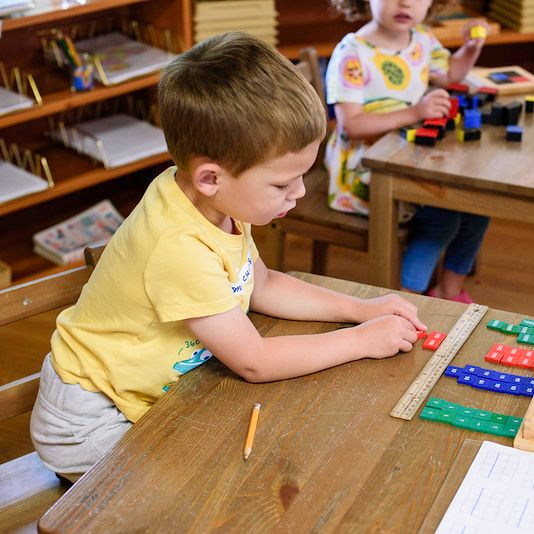
The child still absorbs from the environment but now does so more consciously and purposefully. This is the classic 'Montessori classroom' stage, with more hands-on sensorial and practical life work, exploration, early math and language, and refinement of the senses. Independence, concentration, and self-correction develop strongly

ELEMENTARY (6-12 years)
The Reasoning Mind
Split into lower elementary (6-9 years) and upper elementary (9-12 years) programs, the elementary child shifts from sensorial exploration to abstract reasoning, imagination, and 'big picture' thinking. This is when Montessori's Cosmic Education is introduced - big-picture stories about the universe, life, and humanity that connect all subjects. Children develop a strong sense of justice, morality, and social bonding, and thrive on group work and research projects.

MIDDLE SCHOOL (12-15 years)
The Humanistic Mind
As an early adolescent, focus shifts to self-construction as a social being - identity, emotional development, and finding one's place in society. Montessori advocated for practical, real-world experience, including entrepreneurial and community work, alongside academics, to help teens develop confidence, responsibility, and economic independence.