Whether we realize it or not, human beings naturally seek patterns, love to quantify, and thrive on making logical connections. In Montessori education, we often say that human beings possess a "mathematical mind."
Young children have an innate inclination toward order and logic. At The Renaissance International School, our Primary (Children’s House) classrooms harness this natural curiosity. Rather than teaching math as a set of rules to memorize, our environment offers concrete, hands-on experiences that build a deep, intuitive understanding of mathematical concepts—laying a rock-solid foundation for future academic success.
The mathematical journey in Primary is organized into six progressive groups, guiding children from basic number recognition all the way to working with large numbers, place value, and early fractions.
1. Numbers 1 to 10: Building the Foundation
Learning the numbers 1 through 10 involves integrating several distinct concepts: quantity, symbol, name, and order. Montessori materials isolate each concept so children build understanding step-by-step without feeling overwhelmed.
- Quantity as a Whole: Children begin with the Number Rods, alternating red and blue wooden segments that help them feel and see the physical length of "one" versus "ten."
- Symbols & Connection: Through tactile Sandpaper Numbers, children trace numerals with their fingertips, connecting muscle memory to visual symbols. Next, we bridge the gap by matching number cards to the rods.
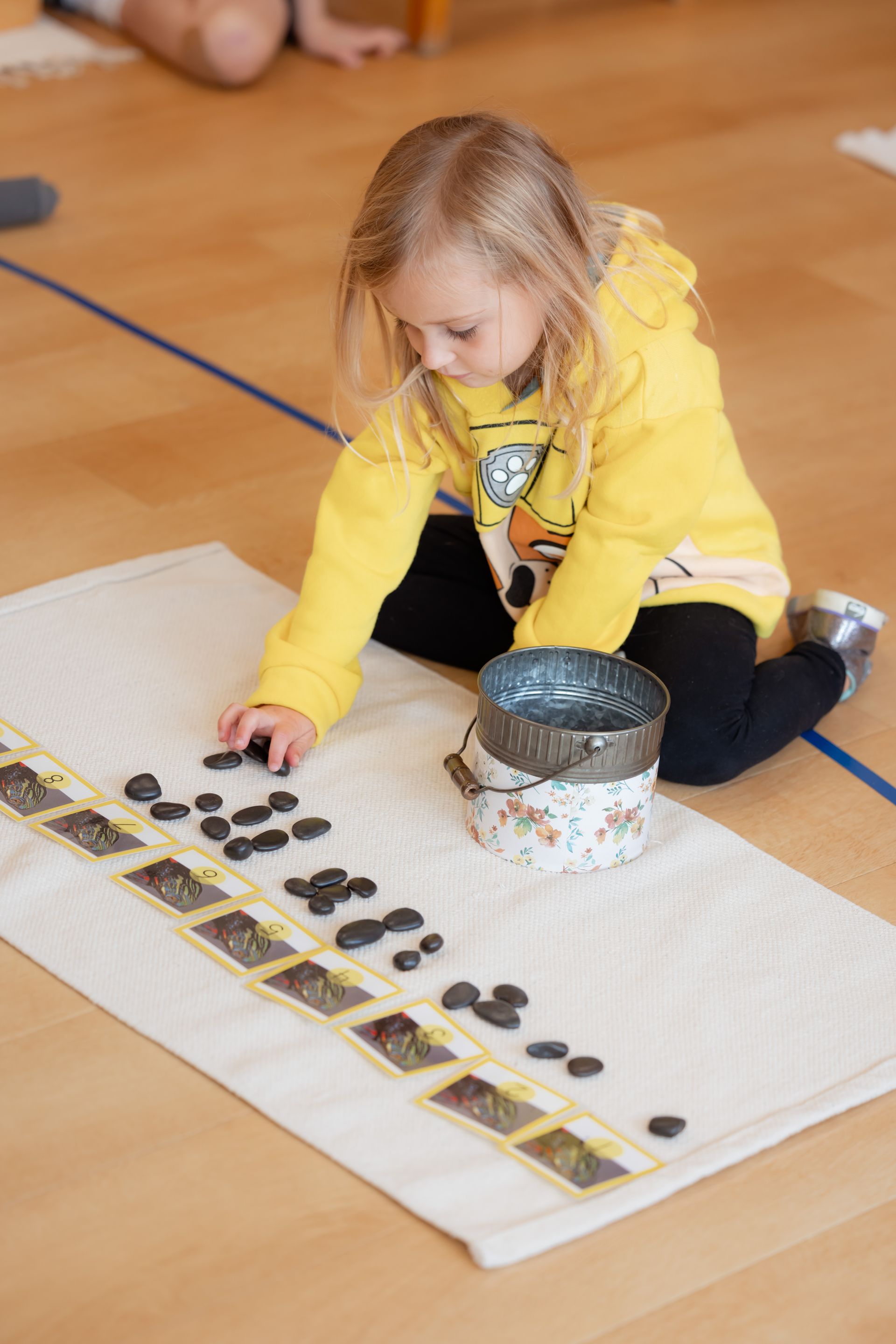
- Sets & Groupings: Exercises like the Spindle Boxes and Cards and Counters transition the child from seeing quantity as a single rod to understanding quantity as a collection of individual objects (and introducing the concept of zero).
Even at this early stage, children receive an informal impression of addition, subtraction, multiplication, and division through simple, hands-on grouping games.
2. The Decimal System: Big Numbers and Concrete Operations
Once a child has mastered 1 to 10, they are introduced to one of the most beloved materials in the Montessori classroom: the Golden Beads.
Because children already understand 1 through 9, they easily grasp the base-10 structure. By physically holding a single unit bead, a ten-bar, a hundred-square, and a thousand-cube, children experience place value sensorially. A thousand-cube is heavy; a unit bead is tiny.
Using these beads, children perform real mathematical operations—addition, subtraction, multiplication, and division—with numbers into the thousands. We focus heavily on the process of putting quantities together or taking them apart, ensuring children understand what addition or division actually means before moving to pencil and paper.
3. Continuation of Counting: Teens, Tens, and Skip Counting
In this phase, children extend their understanding to numbers 11 through 100 and consolidate linear counting up to 1,000.
- Teen & Tens Boards: Children combine numeric symbols and bead quantities to understand how "10 and 1" make 11, or how 20, 30, and 40 function.
- The Colored Bead Stair: A color-coded representation of quantities 1 to 10 that appears throughout higher-level math materials.
- Bead Chains: Children unfold long chains of beads across the rug, discovering the physical difference between a square of 100 and a cube of 1,000. Skip-counting along these chains naturally lays the groundwork for multiplication tables later on.
4. Exploration and Memorization of Essential Math Facts
Memory work in a Montessori classroom is never about dry drills or anxiety-inducing flashcards. Instead, memorization happens naturally through joyful repetition and visual exploration.
Using tools like the Addition & Subtraction Strip Boards, the Snake Games, and the Multiplication Bead Board, children explore combinations again and again. Seeing that five groups of six beads equal thirty builds a vivid mental image. Over time, children realize it is faster to recall 5 times 6 = 30 from memory than to lay out the beads—prompting a smooth, confident leap to mental math.
5. The Passage to Abstraction
As children reach the upper end of their Primary years (around ages 5 to 6), their cognitive needs evolve. They move from needing physical materials to thinking abstractly and logically.
Using advanced materials like the Small and Large Bead Frames (a Montessori abacus) and the Racks and Tubes (a division material), children handle multidigit calculations and numbers into the millions. The materials gradually become less concrete and more symbolic, guiding the child comfortably toward solving equations on paper.
6. Fractions: Quantities Smaller Than One
Fractions are introduced sensorially long before children encounter them in formal work. Using green metal fraction apples and circles split into halves, thirds, fourths, and beyond, children explore how parts form a whole. They practice simple fraction addition and discover equivalent fractions 2/4 = 1/2 by physically placing metal pieces over one another.
Nurturing Lifelong Mathematical Confidence
In our Primary classrooms at The Renaissance International School, math is not a subject to be feared; it is an engaging puzzle to be solved. By moving systematically from concrete experience to abstract understanding, we help children build logical reasoning, classification skills, and a genuine joy in learning.
We invite you to see our mathematical minds in action.
Schedule a tour
to observe a Primary classroom during the morning work cycle.