Alvin Ailey was an African American dancer, director, choreographer, and activist. He was born on January 5, 1931 in Rogers, Texas. When he was 12 years old, he moved to Los Angeles, and fell in love with dance when he saw a ballet performance on a school field trip.
He began his training with Lestor Horton, an American dancer and choreographer, learning about the style of modern dance. After Horton’s death, Ailey became the director of the Lester Horton Dance Theater and even began choreographing his own work. In 1958, he founded the Alvin Ailey American Dance Theater, which is located on 92nd street in New York.
Those ages 17- 25 are given the opportunity to travel across the world and perform the dances that were choreographed by Ailey. His goal when creating the company was “ enriching American modern dance,” and “preserving the uniqueness of black cultural expression.” In many of his pieces, it is evident he incorporates a lot of his religion and where he comes from in his dances. In 1969, he founded the Ailey School where students from ages 3-25 can take dance classes such as modern, jazz, ballet, and hip hop. Students from ages 17-25 can also take part in the training for the Alvin American Dance Theatre. The Ailey School allows students from young ages to appreciate the beauty of dance.
Alvin Ailey died on December 1 of 1989 at the age of 58. That same year, many of his friends founded Ailey Camp: a six-week-long program dedicated to the legacy of Ailey that is now found in 10 cities across the U.S.
The campers at Ailey Camp learn four different styles of dance, jazz, ballet, modern, and African. After the program, the students hold a performance showcasing their hard work. They also take classes like Creative Communication where they learn to express themselves in ways other than dance, and Personal Development, where they can get in touch with themselves. Ailey Camp students have the opportunity to learn dances choreographed by either Alvin Ailey himself or the three other company directors that came after Alvin Ailey. Anyone from ages 11-14 can attend Ailey Camp.
One of the amazing things about this program is that it is completely free. Students are provided with both buffet breakfasts and lunches and free transportation options. This program “develops self-esteem, self-discipline, creative expression, critical-thinking and goal-setting skills in a supportive environment.” All these I can attest to since I have already attended Ailey Camp twice.

This year will be my third time attending Ailey Camp. I decided to return again because I believe Ailey Camp is an amazing experience, and I am very grateful I was given the opportunity to attend. I fell in love with dance on my first day of camp back in the summer of 2022. I realized what dance meant to me and the things I could portray with just a couple of movements. I learned styles of dance that I don’t think I would have ever known and made many friends that I still talk to to this day.
At camp, I not only was surrounded by people who looked like me but I learned why that was so important. I also learned a lot of things other than dance. For one, I learned the importance of leadership. My last day of my first summer at Ailey Camp, I was one out of two students who was chosen for the award of Ailey ambassador. I was chosen for this award because I modeled the Ailey principles for all six weeks of camp. I did not expect to win the award. All I did was participate in all my classes and followed the rules. What’s so special about that? But what I hadn’t realized was that the group leaders saw something in me that I didn’t see in myself.
They saw the way I carried myself throughout camp, maintained a positive attitude, led my fellow campers, and my love for dance. Ailey camp helped me see something in myself that I had never seen before. The role I was given as an Ailey ambassador was a job I took very seriously during and outside of camp. In my second summer of camp, I was the only camper chosen to be interviewed by Cal performances. They asked me questions about my experience, and why I had chosen to return. That opportunity once again reminded me of the many opportunities Ailey camp has given me. I hope that all Ailey campers enjoy the experience and do not take it for granted.
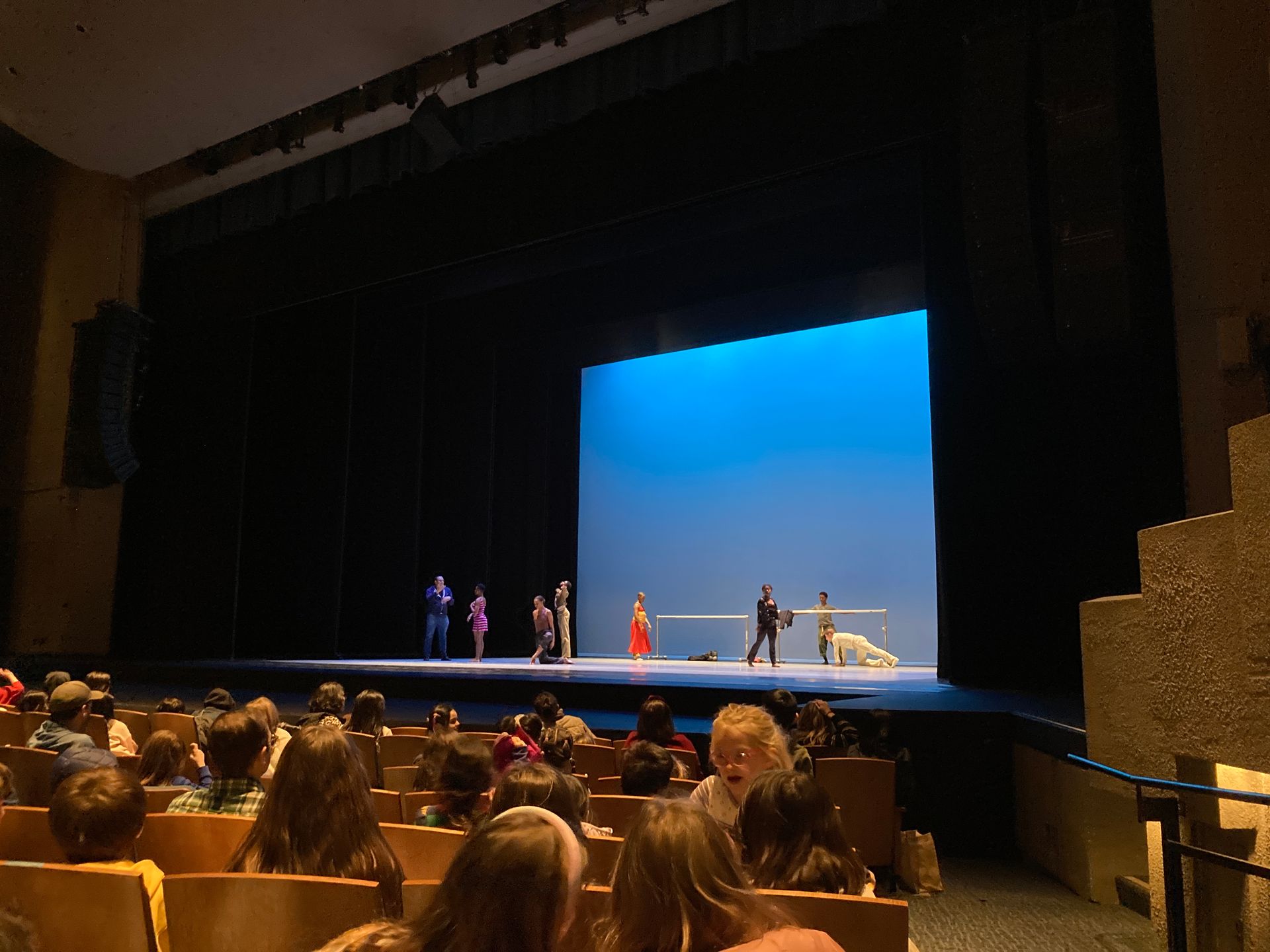
When Upper Elementary and Junior High watched the Alvin Ailey American Dance Theatre (https://www.alvinailey.org/) perform at Zellerbach Hall, Berkeley back in April, we saw an abbreviation of the Revelations collection, created in 1960. The dances were choreographed by Ailey. The theme of the collection of music, dance, and added visuals that we saw was inspired by Ailey’s childhood, his relationship with God, and the overall suffering of African Americans in the South.
When putting the collection together, Ailey did extensive research on the time it was based, and he included a lot of his memories from when he was growing up and going to church. Songs like “Wade in the Water” were songs he recalled listening to when we people would be baptized at church. He wanted to include the feelings that black spirituals brought to African Americans back in the day; the ways that he did that would be through the lighting on stage, the brown, yellow, black, and white of the costumes, and the movements the dancers performed. All of these details put together made a beautiful performance that drew the audience's attention.
I have danced one of the songs in the Revelations collection called “I’ve Been Buked,” a dance that unfortunately we did not see that day, but I have watched the Alvin Ailey American Dance Theatre perform it and was astonished to think I did that too. When watching the collection, I was amazed by every detail that was put into the performance. The props, music, movements, lighting, costumes really did come together to showcase the beauty of dance.
Alvin Ailey, to me, was a mastermind. He is someone that I look up to to this day, someone I would love to have known. When watching his pieces, it’s easy to imagine the kind of person he was and how amazing of a dancer he was. He had a creative mind, and although he is no longer here, his work lives through so many people.
Joya Mayberry
2023-24 The Renaissance International School